Epstein documents are authenticated through three layered checks: provenance verification that traces where a file came from and how it was preserved, format-specific technical review of screenshots, emails, and PDFs, and corroboration against independent records such as court filings, agency releases, and deposition transcripts. No single test settles authenticity — confidence comes from independent checks converging on the same answer. This guide consolidates the working standards used by investigators, courts, and careful publishers into one verification workflow that can be applied to any file circulating from the Epstein archive, whether it arrived as an official release or a viral repost. The same layered logic applies whether the goal is court admissibility, editorial publication, or simply deciding how much weight to give a claim before sharing it.
The need for that workflow is practical, not theoretical. Screenshots, email exports, and PDFs circulate quickly and can be genuine in appearance while missing key context such as the sender path, the attachment chain, or full-page metadata. Authentication is therefore a threshold discipline: if provenance is uncertain, conclusions should stay narrow. That single rule separates careful analysis of the files from the rumor loops that recycle cropped images and unverifiable claims. Every check described below serves that rule — each one either raises confidence in a file's origin and integrity, or it flags exactly where confidence is still missing so the gap can be disclosed rather than papered over. Just as important, every validation step gets documented as it happens, so that the decision to publish, hold, or caveat a document can be audited later by editors, readers, or opposing analysts.
Why Verification Happens in Layers
The first distinction to internalize is between lead evidence and court-ready evidence. A social post, a map fragment, or an archived page can establish an investigative lead, but legal reliability requires more: documented source provenance, capture integrity, and corroboration with independent records. Courts apply formal authentication standards — the framework reflected in Federal Rules of Evidence 901 and 902 — while publishers apply an editorial version of the same logic before printing a claim. In both settings the decisive question is identical: can an independent reviewer reproduce the method and reach the same factual baseline? A verification finding that cannot be repeated by someone else is an opinion with extra steps. That is why every layer of authentication, from initial capture to final corroboration, is built around documentation rather than assertion, and why treating open-source material as a documented process rather than a single viral thread is the foundation of everything that follows.
Provenance and Preservation Come First
Before any technical analysis begins, reviewers record where the file came from, who provided it, and the exact source path it traveled. Each artifact is then classified by provenance confidence — high, medium, or unresolved — so that later editorial decisions are auditable and any reader can see which claims rest on which tier. This is what it means to treat verification as a documented process: the record must show where the data came from, how it was preserved, and why the conclusions drawn from it are warranted. Without that chain, even accurate claims can collapse under basic scrutiny, because there is no way to show where the data originated, how it was preserved, or whether it was altered along the way. Capture method and timestamp integrity matter as much as the content itself, which is why the core preservation requirements are consistent across formats:
- Record full URLs, capture times, and acquisition tooling details, so the collection step itself can be audited by another reviewer.
- Store original files with hashes before any annotation, resizing, or format conversion, so later versions can be compared against a fixed reference.
- Preserve context pages that show the surrounding discussion or edit history, not just the target content in isolation.
- Retain archive snapshots when live pages are likely to change, so the finding remains replicable after the original disappears.
- Keep working copies separate from preserved originals, so annotation and analysis never contaminate the reference version other reviewers will check against.
Provenance tracking is the editorial cousin of formal custody documentation. For how investigators log every transfer of digital and physical evidence, start with the fundamentals.
Read: Chain of Custody BasicsFormat-Specific Checks for Screenshots, Emails, and PDFs
A generic authenticity checklist misses the ways each format actually fails. Screenshots are trivially cropped and re-rendered; an email can display a genuine-looking body over a missing or inconsistent routing history; a PDF can carry removable redaction layers or telling revision-history signals. Format-aware checks target those specific failure points, and they work best when the original file — not a compressed repost — is available for inspection. The goal in every case is the same: determine whether the artifact is what it appears to be, and whether the version being examined is the version that actually originated from the claimed source. For screenshots, which are the weakest format and therefore get the strictest treatment, the priority checks are:
- Request the original capture wherever possible, not a compressed or re-shared crop that has lost detail through reposting.
- Inspect cropping boundaries, overlays, and font or rendering anomalies that suggest editing or reassembly.
- Cross-check visible timestamps, interface state, and account identifiers against what the claimed platform would actually display.
- Confirm the same content appears in independent system records — for example, testing a viral email screenshot against the unsealed Epstein-Maxwell messages archived at /documents/correspondence/corr-014.
- For emails, review full headers and routing data, not only the body text, since visible content alone can be copied or reassembled.
- Verify date-time normalization and sender domain consistency across the thread.
- Match quoted threads and attachment names to the underlying files they reference.
- Identify whether the item is original mail, a forward, or an edited export, since each carries different evidentiary weight.
- Compare circulating excerpts against authenticated archive sets, such as the Maxwell-Epstein correspondence from 2010-2015 at /documents/correspondence/cor-b2-001 or the unsealed Dershowitz case-strategy emails at /documents/correspondence/corr-013.
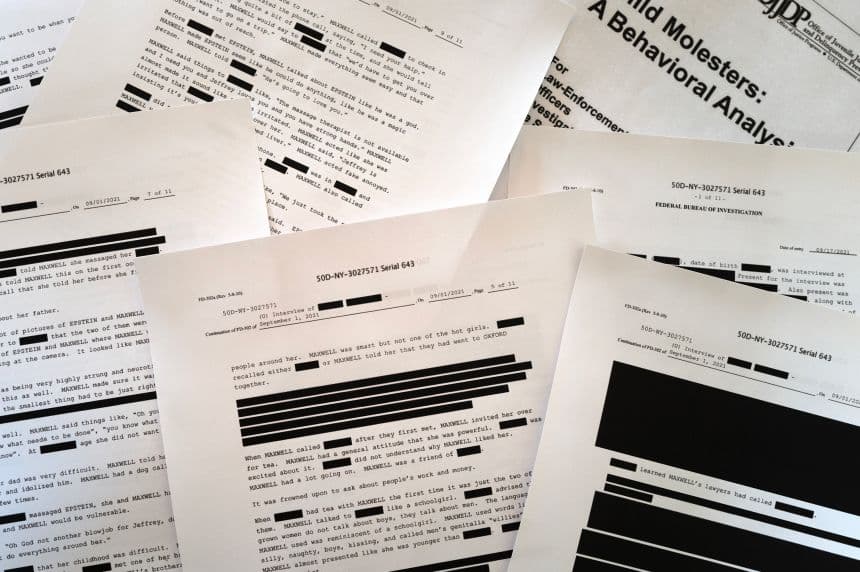
- For PDFs, inspect document properties, producer fields, and revision-history signals before trusting the visible page.
- Check whether redactions are burned in or applied as removable layer masking.
- Compare page numbering, exhibit labels, and Bates markers for continuity with the release the file claims to come from.
- Hash the file and retain version references so later verification can confirm nothing changed.
- Cross-check redaction and versioning claims against release records, such as the Judge Preska unsealing-order timeline at /documents/court-filings/doc-014 and the Sjoberg redacted-versus-released comparison at /documents/depositions/dep-018.
Timestamps, producer fields, and routing data are metadata questions at heart. For how federal investigators validate metadata and what happens when it conflicts, see the dedicated explainer.
Read: Metadata ValidationTesting Claims Against Independent Archive Records
Technical checks establish that a file is internally consistent; corroboration establishes that its content matches independent reality. Evidentiary weight rises when a claim aligns with records, logs, or physical evidence that were created without knowledge of the claim being tested. Open-source findings in particular are strongest when combined with authenticated records, forensic artifacts, or official filings rather than standing alone. The corroboration step also has its own error-reduction rules: timestamps should be validated against timezone-corrected reference events, visual claims should be cross-checked with map, weather, or shadow data when relevant, original-source captures must be separated from reposted derivative media, and any inference that depends on an unverifiable identity assumption should be flagged rather than silently accepted. This is where the public archive becomes an authentication tool in its own right: a circulating document that describes an event, a trip, or a meeting can be tested against primary records that agencies and courts produced on their own timelines, for their own purposes. Because those records were not created in response to the viral claim, agreement between them and a circulating file is meaningful — and disagreement is a warning sign that deserves attention before anything gets repeated. Useful verification baselines include:
- FBI FD-302 witness and victim interview reports at /documents/fbi-records/fbi-024, which show how agents formally document statements with dates and case context.
- The FBI search warrant affidavit for 9 East 71st Street at /documents/fbi-records/fbi-020, a sworn account of what investigators expected to find and why.
- The FBI evidence inventory from that Manhattan search at /documents/fbi-records/fbi-027, which lists what was actually seized and logged.
- CBP travel records released under FOIA at /documents/foia/foia-001, a baseline for testing chronology and travel claims.
- FBI analyst testimony on phone and travel records at /documents/depositions/dep-b2-015, which demonstrates how technical records are presented and challenged under oath.
- The DOJ full-text search portal at /documents/doj-disclosures/doc-012, for checking whether a quoted passage actually appears anywhere in the released files.
The best way to build verification instincts is to work with primary agency files directly. Browse the FBI records collection and practice cross-checking claims against the originals.
Browse: FBI RecordsHow Corroboration Works in Multi-Witness Testimony
Documents rarely stand alone; in high-attention investigations they are read alongside witness accounts, and corroboration between the two is often misunderstood as requiring witnesses to tell the same story in the same words. That is not the standard. Strong corroboration comes from independent accounts that align on material elements — presence, timing window, sequence order, relevant actions — while still reflecting different vantage points, memory detail, and emphasis. Honest accounts commonly diverge in predictable ways: one witness recalls an exact timestamp while another remembers only approximate sequence, two people describe the same location with different words, or perceptions of motive differ even though the event description matches. None of those variations defeats corroboration when the core factual claim holds. Analysis improves when reviewers separate core-event alignment from peripheral variance instead of forcing every claim into a binary true-or-false frame. Investigators weigh corroboration strength using a consistent set of factors:
- Independence: statements or records developed without shared contamination carry the most weight; overlap shaped by shared media coverage, joint interviews, or leaked summaries must be discounted and disclosed.
- Materiality: agreement counts most when it lands on the elements the claim actually depends on, not on incidental detail.
- Record alignment: testimony gains weight when it matches documentary or technical records, such as the key exhibits unsealed in Giuffre v. Maxwell at /documents/court-filings/doc-016.
- Stability: accounts that hold steady across time and review cycles outrank accounts that shift under attention.
- Calibration: when corroboration is partial, publish what is corroborated, what is unresolved, and what new evidence would change confidence.
When witnesses disagree about sequence, documentary timelines often resolve the conflict. See how investigators rebuild chronologies from call logs and flight records.
Read: Timeline ReconstructionFailure Modes and Publication Discipline
- Conflating correlation with direct evidentiary linkage — two facts appearing together is not proof that one establishes the other.
- Relying on cropped or second-hand media without recovering the original source file.
- Skipping archive preservation, which destroys anyone else's ability to replicate the finding later.
- Treating anonymous account claims as factual without independent verification.
- Building identifications or timelines on assumptions about who is behind an account or in an image that cannot be verified from preserved material.
- Letting conclusions depend on a file whose provenance is unresolved, instead of labeling the material unconfirmed and keeping the claim narrow.
The failure modes above share a common root: skipping the documentation that makes a finding checkable. The final stage of the workflow is therefore publication discipline. Corroborate key claims against at least one independent record source, publish uncertainty notes where validation remains incomplete, and label unconfirmed material explicitly rather than letting placement imply endorsement. Authentication before publication is a user-protection step, not a legal formality: it is what prevents high-similarity rumor loops and preserves long-term credibility as new releases arrive and earlier claims get re-tested. It is equally important to state what authentication does not do. A genuine document proves only that the record exists and says what it says — appearing in an authentic file is not a finding of wrongdoing, and all individuals named in these records are presumed innocent unless proven guilty in a court of law.
Every check in this guide assumes the underlying data was captured without alteration. For how investigators preserve original device data before analysis ever begins, read the forensic imaging explainer.
Read: Forensic ImagingContinue Reading
Explore Archive Hubs
Sources & References
Frequently Asked Questions
Is a screenshot enough to verify an Epstein document claim?
Usually no. Screenshots are the easiest format to crop, edit, or re-render, so they should be corroborated with original files, system records, or independently verifiable sources before any strong factual claim is published.
What is the most important check for a leaked email's authenticity?
Header and routing validation. Visible body text alone can be copied or reassembled, so reviewers verify the full headers, sender domain consistency, and date-time normalization, then compare the content against authenticated correspondence in the archive.
Can open-source research alone establish that a document is genuine?
Usually no. Open-source findings are strongest as leads, and they become defensible only when combined with authenticated records, forensic artifacts, or official filings that independently support the same conclusion.
What makes a verification finding reproducible?
A documented capture method, preserved original files with hashes, reliable timestamps, and clear steps another reviewer can repeat to reach the same factual baseline. If the method cannot be repeated, the finding cannot be relied on.
Do witnesses have to match word-for-word for their accounts to corroborate a document?
No. Corroboration turns on independent convergence in material facts — presence, timing, sequence, and actions — not identical language. Peripheral differences between honest accounts are normal and sometimes expected.
How should publishers handle documents that cannot be fully authenticated?
Label them explicitly as unconfirmed, keep conclusions narrow, and publish uncertainty notes describing what validation remains incomplete. No conclusion should depend on a file whose provenance is unresolved.
Disclaimer: All information in this article is sourced from publicly available court records, government FOIA releases, and credible news reporting. This is informational content. Inclusion or mention of any individual does not imply wrongdoing. All persons are presumed innocent unless proven guilty in a court of law.