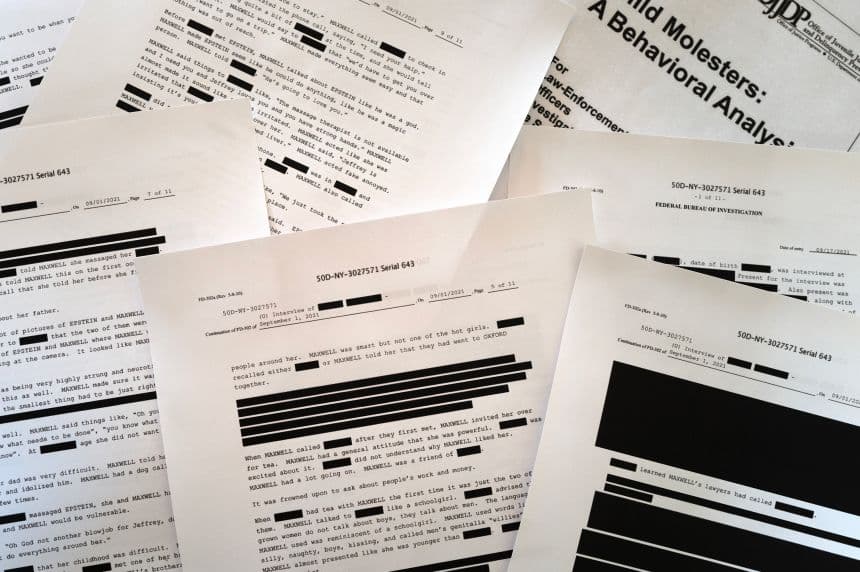
To read the Epstein files critically, treat every document as bounded evidence: confirm what the visible text actually says, interpret it by document type, issuer, and date, and label everything the record does not show as unresolved rather than filling the gaps with assumptions. Three disciplines make that possible — careful redaction reading, three-layer source triangulation, and explicit confirmation-bias controls — and this guide walks through each one, with primary records from the archive you can practice on. The method is not about distrusting the files; it is about separating what a record confirms from what commentary claims it confirms, so your conclusions survive the next release wave instead of being overturned by it.
Treat Every Document as Bounded Evidence
Redacted PDFs are evidence of both disclosure and withholding. They show that records exist, but they do not reveal every factual element needed for final conclusions. In high-interest investigations, readers often treat blacked-out lines as proof of the most dramatic explanation, when the stronger move is to separate what the visible text confirms from what the redactions leave unresolved. A redaction marks withheld content — it is not automatic proof of any specific hidden fact, and different exemptions can apply to adjacent lines on the same page. Reading this way keeps the record itself, not the reader's expectation, in charge of the conclusion.
- A redaction usually tells you a legal or policy basis for withholding likely applies — not what sits underneath the black bar.
- Document structure and section sequence remain useful context even when individual lines are masked.
- A redacted record may still support partial factual conclusions, provided the limits are clearly defined.
- Additional releases or litigation can later change what is visible, so today's reading should be dated and revisable.
- Error one: assuming redaction size equals the importance of the hidden content.
- Error two: treating repeated blackout patterns as proof of one specific narrative.
- Error three: merging claims from social posts into the gaps without record support.
- Error four: ignoring that different exemptions can apply to adjacent lines, so one page can mix several kinds of withholding.
A Workflow for Reading Redacted Records
Start by mapping the document's metadata, then annotate only visible factual statements. Next, compare the redacted record with related filings, production logs, and timeline entries that may clarify context. Finally, classify each open question as unresolved rather than resolved-by-inference. This sequence keeps reporting accurate and reduces error cascades in follow-up coverage: a mistake caught at the annotation stage never becomes a viral claim. The workflow below builds those habits against real records in the archive.
- Capture page-level citations for every confirmed claim, and keep analyst inference in a separate column from direct text evidence.
- Compare redacted and released versions of the same material — the Sjoberg deposition redacted-versus-released comparison shows how much an interpretation can change once blackouts lift.
- Place each record in its release sequence using the Judge Preska unsealing-orders timeline and the 2019–2025 document release comparison before treating any page as new information.
- Track unresolved sections for future release or court review — heavily masked pages such as the redacted FBI 302 witness interview reports can look very different after later disclosure, so date your annotations and revise earlier interpretations when new unredacted material appears.
Before labeling any line in a filing, decide which category it belongs to: allegation, evidence, or adjudicated fact. Our companion explainer sets out the full classification framework this guide relies on.
Read: Allegation vs Evidence vs Adjudicated FactRun Every Claim Through Three Layers of Triangulation
Triangulation is the core defense against false certainty in high-noise investigations. A single source, even an authoritative one, rarely captures full procedural context. Reliable analysis usually requires at least three aligned layers: a primary record, independent corroboration, and chronology validation. Without that structure, repeated claims can look stronger than they actually are — and in the Epstein files, where thousands of pages circulate as screenshots and excerpts, that illusion of strength is the single most common failure mode.
- Layer 1 — the primary artifact: the filing, order, transcript, or official release itself, such as the USA v. Maxwell trafficking-conspiracy indictment, rather than a summary or screenshot of it.
- Layer 2 — independent corroboration: a separate institution or record stream, for example testing a court-derived claim against the DOJ's February 27, 2025 release or the full CourtListener docket of 1,800-plus entries.
- Layer 3 — the chronology test: confirm the sequence of events holds and that no dated record materially contradicts the claim.
A claim should remain provisional until it passes all three layers. This prevents overreaction to early fragments and keeps your notes coherent when late-stage records appear. It also exposes the echo-chamber problem: in viral cycles, one unverified assertion is often paraphrased across many posts, and volume creates the illusion of confirmation even when every post relies on the same untested origin. Triangulation counters this by focusing on source independence, not source count — ten articles restating one claim are still one source. Where uncertainty remains, publish confidence levels instead of binary true/false language.
Flight-log and manifest threads are where triangulation failures show up most often — names, dates, and destinations get merged into claims the underlying records do not support. See how the method applies to those specific documents.
Read: Interpreting Viral Flight-Log ClaimsWatch for Confirmation Bias in Your Own Reading
Confirmation bias in document analysis usually appears as selective attention: readers notice details that support prior beliefs and discount details that conflict with them. In fast-moving controversy cycles, this turns ambiguous records into overconfident narratives. The bias often enters before analysis even starts — in which sources you select and which framing assumptions you carry into the first page. A bias-aware workflow keeps interpretation anchored to verifiable text rather than expectation.
- Choosing excerpts that fit a narrative while ignoring the full document context.
- Treating ambiguous wording as decisive when it happens to support prior assumptions.
- Downweighting corrective records because they are less attention-grabbing than the original claim.
- Using certainty language before any adjudicated findings exist.
Effective controls are procedural, not motivational — telling yourself to be objective does not work, but structure does. Require dual annotations: one column for evidence supporting your working hypothesis and another for contradicting evidence. Add a mandatory alternative-explanation section before you publish or share a conclusion. Use blind second review for key claims and citations, score claims by evidentiary tier rather than social traction, and document why conflicting records were accepted or rejected. Finally, set revision thresholds in advance: define what kind of new record would reopen a conclusion, so updating is routine rather than an admission of failure. Team review catches interpretive drift better than solo analysis, because the reviewer does not share your accumulated assumptions.
Practice on Primary Records From the Archive
Method sticks when it is applied, not memorized. Each exercise below pairs a real record from the archive with one skill from this guide — redaction discipline, classification, or triangulation. Work through them in order and keep written annotations; the notes you produce become the baseline you test future claims against.
- Read the January 3, 2024 unsealed documents alongside the January 8, 2024 unsealing order that released additional names, and annotate which statements are allegations, which are evidence, and which reflect adjudicated findings.
- Study the order denying the petition to unseal Florida federal grand jury transcripts to practice separating what a court has confirmed from what remains withheld.
- Use the motion for a protective order in Giuffre v. Maxwell to practice interpreting a record by its document type, issuer, and date before inferring significance.
- Open a heavily redacted release such as FBI Vault Part 02 and annotate only the visible factual statements, logging every blacked-out section as an open question rather than a conclusion.
- Pick one viral claim and trace it to its origin through the DOJ full-text search portal, recording the original source and first publication timestamp before checking whether corroborating sources are truly independent.
Agency releases are ideal practice material because they arrive with exemption markings and staged disclosure built in. Browse the FOIA records collection to apply the redaction workflow at scale.
Browse: FOIA Records CollectionA Checklist for Any New Release
- Identify the original source and first publication timestamp before sharing anything.
- Check whether corroborating sources are independent or restatements of a single origin.
- Map claim language to exact record citations, at page level wherever possible.
- Separate direct text evidence from analyst inference in your notes.
- Score claims by evidentiary tier, not by social traction.
- Mark unresolved contradictions and defer final interpretation until records resolve them.
- Publish confidence levels instead of binary true/false language where uncertainty remains.
- Revise earlier interpretations when new unredacted material meets your predefined revision thresholds.
New to the document sets themselves? Start with the step-by-step guide to searching the DOJ Epstein library, then bring each result back through the checklist above.
Read: DOJ Library Search GuideCritical reading cannot be fully separated from humility about what the files show. Redacted records can be highly informative when treated as bounded evidence, triangulated claims can be published with earned confidence, and bias controls make both durable — but every conclusion should remain open to revision when new material appears. That discipline matters most for the people named in these documents: appearing in a file, a log, or an unsealed exhibit is not a finding of wrongdoing, and all individuals named in these records are presumed innocent unless and until allegations against them are proven in a court of law. Reading critically means holding that line even when a dramatic inference would be easier — because the archive rewards patience, and the record eventually speaks for itself.
Continue Reading
Explore Archive Hubs
Sources & References
Frequently Asked Questions
Does heavy redaction in the Epstein files mean misconduct is being hidden?
No. A redaction marks content withheld under a legal or policy basis, not proof of any specific hidden fact. Treat blacked-out sections as open questions, and update your conclusions only when later releases or litigation make more of the text visible.
How many sources do I need before treating a claim about the files as confirmed?
Independence matters more than count. A strong minimum is one primary record, independent corroboration from a separate institution or record stream, and a chronology check confirming the sequence holds without material contradiction. A claim should stay provisional until it passes all three layers.
Do multiple news reports repeating the same claim count as corroboration?
Only if they rely on independent underlying evidence. When many posts and articles paraphrase one untested origin, volume creates an illusion of confirmation without adding any verification — that is echo, not corroboration.
What is the clearest sign that confirmation bias is shaping my reading?
Consistent emphasis on fragments that support your working theory while contradictory records are minimized or omitted. Dual annotation — one column for supporting evidence and one for contradicting evidence — makes that drift visible before it hardens into a conclusion.
What should I do when two credible sources conflict?
Mark the claim unresolved, document the contradiction explicitly, and avoid definitive language until stronger records resolve the discrepancy. Publishing a confidence level is more accurate than forcing a true/false verdict.
How should I handle sections of a document that remain redacted?
Track them as unresolved items tied to page-level citations, and revisit them when unsealing orders or new release waves change what is visible. Date your annotations so you can tell which interpretation was based on which version of the record.
Disclaimer: All information in this article is sourced from publicly available court records, government FOIA releases, and credible news reporting. This is informational content. Inclusion or mention of any individual does not imply wrongdoing. All persons are presumed innocent unless proven guilty in a court of law.