Epstein's victims hold enforceable rights in federal court under the Crime Victims' Rights Act (CVRA), 18 U.S.C. § 3771: reasonable and timely notice of public proceedings, the opportunity to be heard at key phases such as release and sentencing, the right to confer with government counsel in defined contexts, and treatment with respect for dignity and privacy. Those rights are procedural — they do not make victims parties to the criminal case, and they never guarantee a particular charging, sentencing, or restitution outcome. That gap between process rights and outcome guarantees explains almost every victims' rights fight in the Epstein record, from the challenge to the non-prosecution agreement through the Maxwell sentencing. This guide consolidates the full picture across six areas — CVRA participation, victim impact statements, restitution and civil damages, limitation and revival windows, minor-victim confidentiality, and interview standards — and connects each one to the primary records preserved in the archive.
What the Crime Victims' Rights Act Promises
The CVRA is a procedural rights framework for federal criminal matters, and its boundaries explain most of what courts can and cannot do for victims. It requires meaningful notice, structured opportunities to participate, and dignity protections, but it does not convert victims into litigants who control the prosecution. When a right is allegedly violated, the dispute is raised through motion practice: victims or their counsel file papers identifying notice or participation failures, the government responds with its account of the process and the remedies available, and the court clarifies the applicable rights through hearings and orders. If compliance or interpretation disputes continue, follow-up filings extend the fight across multiple hearings. That filing-response-order rhythm is why serious coverage tracks docketed rulings rather than hearing summaries alone — the docketed language, not the headline, is the authoritative record of what a court actually decided.
- Reasonable and timely notice of public court proceedings, so victims are not learning about hearings after the fact.
- The opportunity to be heard at key phases of the case, including release determinations and sentencing.
- The right to confer with government counsel in defined contexts — a conferral right, not a veto over prosecutorial decisions.
- Respect for dignity and privacy, along with protection from unreasonable delay in the proceedings.
Equally important is what the statute does not automatically guarantee. It does not promise a specific charging or plea outcome, it does not override every confidentiality or sealing constraint, it does not replace judicial discretion in sentencing determinations, and it does not resolve restitution disputes on its own. A rights assertion is not the same as a guaranteed result. Reading CVRA coverage well means identifying three things that frequently diverge: the specific right asserted, the remedy requested, and the remedy the court actually granted.
The NPA Fight: Victims' Rights Meet the Epstein Docket
No records illustrate both the power and the limits of the CVRA better than the litigation over Epstein's 2007 federal non-prosecution agreement. Victims who were never told about the secret deal sued under the CVRA in Doe v. United States, arguing that the government's handling of the agreement violated their rights to notice and conferral. Judge Marra's landmark ruling found that the NPA process violated victims' rights — a finding that reshaped public understanding of the original Florida resolution and drove years of follow-on scrutiny, including internal reviews of how victim notification failed. The archive preserves that litigation trail end to end, from the initial complaint through the notification-failure reviews and compliance records that followed.
- The Doe v. United States CVRA complaint that challenged the non-prosecution agreement in federal court.
- Judge Marra's landmark CVRA ruling, finding that the NPA violated victims' rights.
- The Doe plaintiffs' litigation strategy for attacking the secret NPA.
- A constitutional analysis of the CVRA's conferral right as it played out in Doe v. United States.
- The Inspector General review of NPA victim notification failures.
- FBI victim notification records and CVRA compliance files, showing how notice obligations were handled in practice.
- Wild's 2019 statement supporting the challenge to the NPA.
Every dispute in this guide traces back to primary records. Start with the sworn statements, declarations, and courtroom testimony preserved in the victim testimony archive.
Browse Victim Testimony RecordsThe Right to Be Heard at Sentencing
Victim impact statements are the CVRA's participation right made visible. They are a formal channel for survivors to describe harm during the sentencing phase — the personal and practical effects of the offense, and how those effects continued over time. Statements can be submitted in writing, delivered orally in court, or presented in both formats, and some details may be redacted or filed under seal for privacy. What they influence is real but bounded: they shape how the court understands harm severity and downstream consequences, and they focus sentencing-phase attention on survivor-facing effects. They do not dictate outcomes by themselves; courts still apply statutory factors and guideline considerations across the full record, and public summaries often omit the procedural nuance in the filed documents. The Maxwell sentencing produced one of the most complete public examples of this process on record, in both written filings and courtroom addresses.
- Written victim statements submitted to the court among the Maxwell sentencing filings.
- Oral testimony as victims addressed Judge Nathan at the Maxwell sentencing hearing.
- Profiles of the eight women who spoke at the Maxwell sentencing.
- A Jane Doe victim impact statement filed for the Maxwell sentencing.
- Wild's statement at the 2022 Maxwell sentencing, the capstone of a long victims' rights campaign.
- Victim allocutions at the post-death hearing, where survivors addressed the court after Epstein's death.
Impact statements, courtroom addresses, and survivor declarations are gathered in one curated set for side-by-side reading.
Open the Victim Statements CollectionRestitution, Civil Damages, and Compensation Claims
Money flows to survivors through two distinct legal lanes, and mixing them up is the most common error in coverage of the Epstein litigation. Criminal restitution is a criminal-case remedy: it is addressed through sentencing-related process, governed by statutory rules on compensable loss categories and calculation methods, and constrained by case posture. Civil damages arise from separate civil claims — including suits against the Epstein estate — with their own pleadings, proof dynamics, timelines, and settlement pressures that have no counterpart in sentencing. A result in one lane does not determine the outcome in the other: restitution amounts are not proxies for civil damages, and civil settlements do not imply criminal-liability findings. Every figure should be labeled by forum and by status — proposed, ordered, settled, or contested — before it is compared to any other number, and summaries should be updated when official court documents modify prior figures.
- The Doe v. Epstein Estate class action brought on behalf of more than 130 victims.
- A Jane Doe victim suit against the Epstein estate, showing how individual civil claims were pleaded.
- Records on the $121 million victim compensation program funded through the estate.
- The compensation program's final report, documenting distributions to more than 150 claimants.
- The fund's financial distributions broken down by award tiers.
For the full story of how the claims program worked and what it delivered for survivors, read the deep dive on the $121 million compensation fund.
Read: The $121M Compensation FundTiming Rules: Limitation Periods and Revival Windows
Whether a survivor's claim can proceed at all often turns on timing rules that vary sharply by forum. Criminal limitation periods are set by criminal statutes and charging frameworks; civil deadlines are tied to specific causes of action and forum-specific legislation — and the two systems are not interchangeable. Revival windows add another layer: some jurisdictions have enacted laws that reopen certain otherwise time-barred civil claims for a defined period, which is one reason survivor suits can appear years after the underlying events. Whether a specific claim qualifies depends on the statute's text, the claim type, and precise dates. A sound timing analysis identifies the forum first, then pins down incident dates, filing dates, and the statute version in effect — including amendments passed after the events — and checks whether tolling or revival provisions plausibly apply before drawing any conclusion about viability. Media summary dates are no substitute for filed-record dates, and one jurisdiction's revival model should never be treated as nationwide practice.
Confidentiality, Interview Standards, and Survivor Protection
Because many of Epstein's victims were minors when the abuse occurred, the records are shaped throughout by confidentiality safeguards: name and identifier redactions, Jane Doe pseudonyms and initials in public-facing filings, sealed attachments with restricted access, and protective orders limiting downstream disclosure. Courts must balance transparency principles against specific child-protection duties, which produces partially public dockets — legal posture visible, sensitive details withheld. That mixed state is structured protection, not a lack of accountability. It also creates real re-identification risk for anyone writing about these records: combining public fragments, publishing narrow location and time details, or repeating archived names from older material can expose protected individuals even when every individual source was technically public. Responsible use of the archive means confirming what is sealed, redacted, and fully public before publishing, and avoiding contextual detail combinations that narrow a protected identity.
- The motion for a protective order in Giuffre v. Maxwell, showing how discovery restrictions were sought.
- A Jane Doe protective-order motion in the state prosecution.
- The order denying that protective-order motion as moot — a reminder that requested and granted relief can diverge.
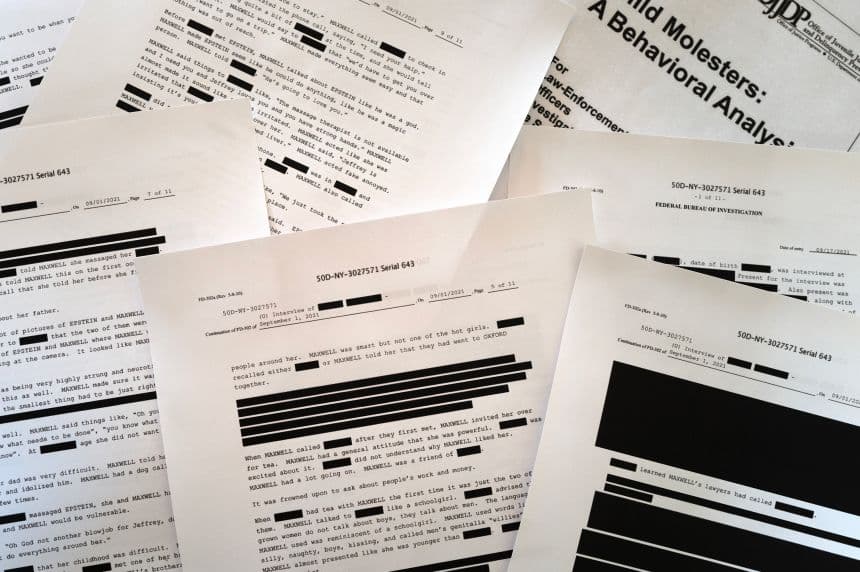
- FBI victim interview summaries from 2006, showing how survivor accounts first entered the federal file.
- FBI FD-302 reports of witness and victim interviews, the bureau's interview write-ups in redacted form.
How those interviews were conducted matters as much as what they say. Trauma-informed interviewing is not softer evidence collection; done correctly, it is better evidence collection — clear explanation of process, rights, and scope, structured questioning that minimizes suggestion, documented pacing and breaks, and consistent recording practices for later review. The recurring pitfalls run the other way: leading or compound questions that blur factual boundaries, interrupted chronologies, inconsistent documentation across interview rounds, and uncoordinated interviewer handoffs that force survivors to repeat their accounts. This is essential context for reading the interview records above: apparent variations between a survivor's early and later accounts can reflect process design rather than deliberate contradiction. Before treating a quote difference as impeachment, check the interview method, the sequence, and whether corroborating records support the key factual points.
The stakes of victim notice and interview practice are not abstract. Read how the first accuser's 1996 FBI complaint was ignored.
Read: Maria Farmer's 1996 ReportHow to Follow a Victims' Rights Dispute in the Record
Victims' rights coverage rewards a docket-first method. Identify which specific right is at issue in each filing, and separate the remedy requested from the remedy granted — court orders, not hearing coverage, are the authoritative record. Track timing, because rights disputes evolve across multiple hearings and follow-up filings. Label every monetary figure by forum and legal status before comparing it to any other number. Confirm what is sealed, redacted, and public before treating an absence as a revelation, and avoid detail combinations that could re-identify protected individuals. Applied consistently, that method turns the archive's victim-facing records — CVRA motions, impact statements, compensation reports, and protective orders — into a coherent account of what survivors were owed, what they asked for, and what the system actually delivered. A final note on fairness: these documents record allegations, procedure, and testimony; inclusion of any individual's name does not imply wrongdoing, and all persons are presumed innocent unless proven guilty in a court of law.
Continue Reading
Explore Archive Hubs
Sources & References
- Cornell LII - 18 U.S.C. Section 3771 (Crime Victims' Rights Act)
- Cornell LII - 18 U.S.C. Section 3663A (Mandatory Restitution)
- Cornell LII - 18 U.S.C. Section 3509 (Child Victims' and Child Witnesses' Rights)
- Cornell LII - Federal Rule of Criminal Procedure 49.1 (Privacy Protection in Filings)
- Cornell LII - 18 U.S.C. Section 3282 (Offenses Not Capital)
- Cornell LII - 18 U.S.C. Section 3299 (Child Abduction and Sex Offenses)
- Office for Victims of Crime
- DOJ Crime Victims Rights Ombudsman
- U.S. Sentencing Commission
- NIJ - Victims and Victimization
Frequently Asked Questions
Does the Crime Victims' Rights Act give Epstein's victims control over charging decisions?
No. The CVRA provides notice, participation, and conferral rights, but charging and plea decisions remain within prosecutorial and judicial processes. That is why the Doe v. United States litigation challenged the process around the non-prosecution agreement — the failure to notify and confer with victims — rather than dictating a charging outcome.
Is criminal restitution the same as suing the Epstein estate for civil damages?
No. Restitution is a criminal-case remedy tied to sentencing and statutory loss categories, while civil damages come from separate civil litigation with its own scope, timing, and procedural rules. A figure from one lane should never be treated as a proxy for the other, and each amount should be labeled as proposed, ordered, settled, or contested.
Do victim impact statements decide sentencing outcomes by themselves?
No. Impact statements are an important part of the sentencing record — they shape how the court understands harm severity and its downstream effects — but courts weigh them alongside statutory factors, guideline considerations, and the broader case evidence before imposing sentence.
Do confidentiality protections for minor victims mean courts are hiding the Epstein case?
No. Courts typically keep procedural case activity public while protecting identifying details through redaction, Jane Doe pseudonyms, sealing, and protective orders. A partially visible docket reflects structured privacy protection required in sensitive cases, not an absence of judicial oversight.
Why do survivor accounts sometimes vary across interviews?
Some variation can stem from interview process quality, context, and question structure rather than witness credibility. Leading questions, interrupted chronologies, and uncoordinated interviewer handoffs all introduce avoidable noise, which is exactly what trauma-informed interviewing standards are designed to reduce.
Do revival windows automatically reopen every survivor claim?
No. Revival laws in some jurisdictions reopen certain otherwise time-barred civil claims for a defined period, but applicability depends on the jurisdiction, the claim type, and the exact statutory conditions in effect. Sound timing analysis requires the offense date, the filing date, and the governing statute version — not generalized assumptions.
Disclaimer: All information in this article is sourced from publicly available court records, government FOIA releases, and credible news reporting. This is informational content. Inclusion or mention of any individual does not imply wrongdoing. All persons are presumed innocent unless proven guilty in a court of law.