Editorial note: This article is sourced analysis based on publicly available court records, government releases, and credible news reporting. Primary documents and reporting referenced are listed in the Sources & References section below and linked in our archive.
On September 16, 2026, the House of Representatives adopted a resolution finding Leon Black, the billionaire co-founder of Apollo Global Management, in contempt of Congress. It capped a standoff that began in June, when Black stopped answering questions about nondisclosure agreements during a voluntary interview for the House Oversight Committee's Epstein investigation. Black has not been charged with any crime connected to Jeffrey Epstein and denies wrongdoing. The contempt fight turns on a narrower question — how far a congressional subpoena can reach into private confidentiality agreements — and it unfolded alongside a new bill that would stop NDAs from silencing survivors of sexual abuse.
This guide reconstructs the dispute from the primary record: the committee's contempt report (H. Rept. 119-831), House Resolution 1543, the Congressional Record, Black's federal lawsuit, and the text of the Survivor's Voice Protection Act (H.R. 10389). Where the two sides disagree, both accounts are described and attributed.
How the Subpoena Fight Began
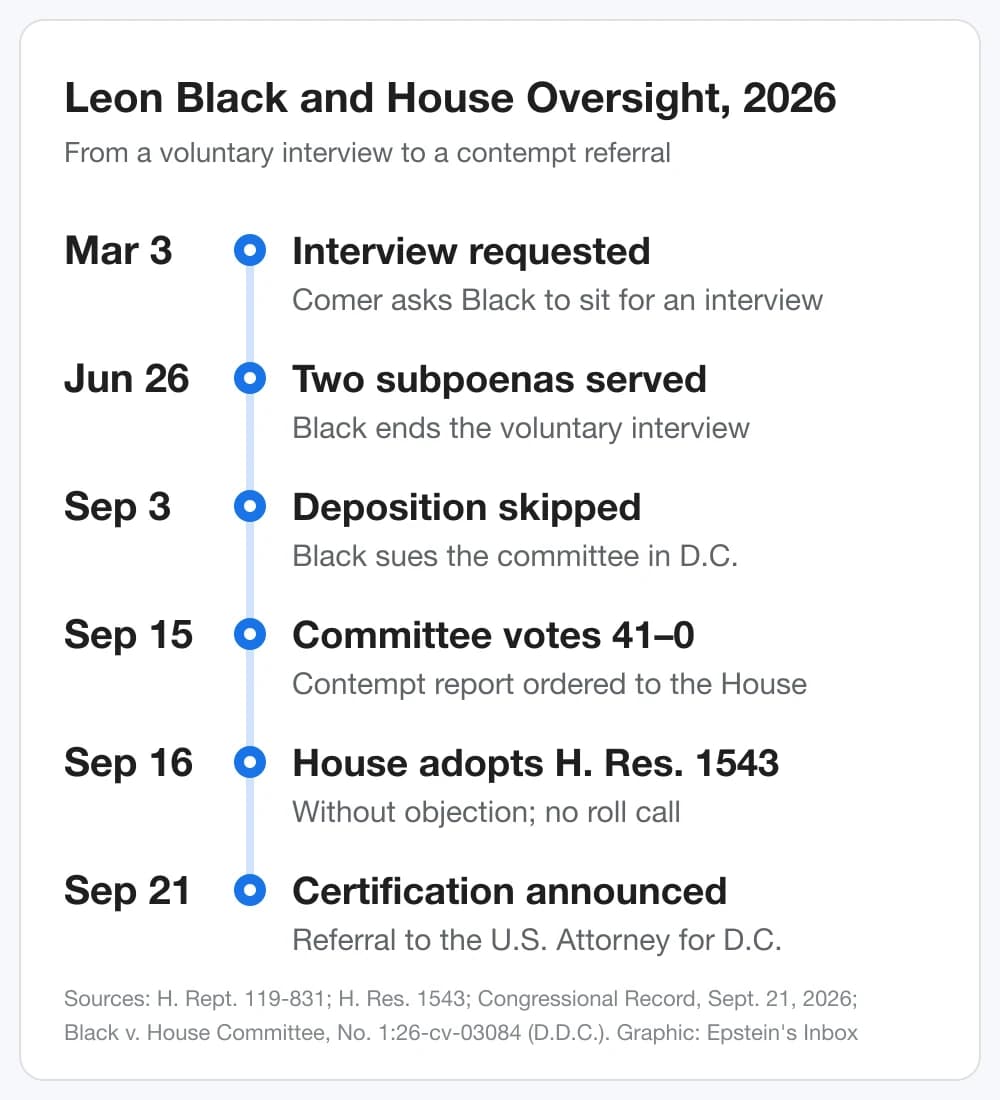
Oversight Chairman James Comer first wrote to Black on March 3, 2026, asking him to sit for a transcribed interview. According to Black's complaint, the letter described an inquiry into Epstein, Ghislaine Maxwell, sex trafficking, alleged failures in the federal investigations, and possible ethics issues involving elected officials. After Black hired new lawyers, committee staff and his counsel met four times between April and June, and the interview was moved from May 13 to June 26.
Accounts of June 26 diverge. The committee says staff questioned Black for the better part of an hour about Epstein-related topics, which he answered, before he declined questions about his NDAs. Black's complaint says Comer publicly announced just before the session that the majority would focus on NDAs and on suspicious activity reports filed by banks, subjects his lawyers say never came up in months of planning talks. Both sides agree on what happened next: Comer had two subpoenas served on Black, one for a sworn deposition and one for documents, and Black and his lawyers ended the interview.
The deposition was first set for July 16 and later moved to September 3 at Black's request. The committee released the transcript of the June interview on July 17, with names and identifying details redacted, according to its report. On July 24, Black's lawyers answered the document subpoena with a letter and a single agreement, and on August 18 Comer rejected their objections in writing. Hours before the September 3 deposition, Black's counsel wrote that he "respectfully declines" to testify, and Black sued the committee the same day. Comer held the session with an empty chair.
The NDAs at the Center of the Dispute
The document subpoena demanded three categories of agreements:
- Every nondisclosure agreement to which Black is a party.
- Every NDA to which Epstein or Maxwell is or was a party.
- Every NDA that references Epstein or Maxwell, or that either of them helped prepare, execute or enforce.
According to its report, the committee wants to know whether Epstein helped draft or administer any of Black's agreements, whether he handled money paid to women who signed them, who those women are, and what their connection to Epstein was. The report also describes a broader goal: understanding how confidentiality agreements can keep victims of sexual abuse or trafficking from coming forward, as groundwork for legislation.
Black's position is laid out in his complaint. He says he has already testified that Epstein played no part in drafting or creating any confidentiality agreement he may have, and that Maxwell had nothing to do with any of them. His lawyers say the women on the other side of those agreements have no known or public connection to Epstein, bargained for privacy, and have declined through their own counsel to release him from confidentiality. The one agreement he produced was, the complaint says, the only one signed while Epstein was alive.
The committee rejects that account. Its report says the document Black produced does not contain the terms he described during the June interview for a 2015 agreement — $100,000 a month for 15 years, $1 million in loan forgiveness, and $2 million in British pounds to obtain a U.K. visa — and that he testified Epstein knew about that agreement. The report adds that most NDAs contain exceptions for legally compelled disclosure, and it argues that a private contract cannot limit Congress's constitutional power to investigate.
Each side accuses the other of refusing to compromise. The committee says it offered to limit its demand to agreements Black signed after he met Epstein, to accept a log listing the agreements first, or to review that log privately, and that Black turned down each option; Black's side has said the committee failed to negotiate any limits, which the report calls false. The committee also says his lawyers offered one more agreement, one already known publicly through litigation, if the committee would drop contempt, convert the deposition into a voluntary interview, confine NDA questions to those two agreements, delay the session to late September or October, and not video-record it. The committee called that offer unreasonable. Black's attorneys have called the House action "outrageous" and said they will fight it.
Black's Lawsuit Against the Committee
Black v. House Committee on Oversight and Government Reform, No. 1:26-cv-03084, was filed in federal district court in Washington, D.C., on September 3 and assigned to Judge Colleen Kollar-Kotelly. It names the committee and Comer, in his official capacity, as defendants and makes three claims:
- The subpoenas exceed the authority the House delegated to the committee.
- They demand private information that lacks a sufficient connection to any valid legislative purpose.
- Congress has not authorized House committees to enforce subpoenas against private citizens through civil lawsuits in federal court.
Black asks the court to declare both subpoenas invalid and to bar the committee from enforcing them. His complaint relies on Watkins v. United States (1957), in which the Supreme Court said Congress has no general authority to expose people's private affairs without a legislative justification; the committee's report quotes the same decision's description of the investigative power as broad. Lawsuits that try to block a congressional subpoena also run into Eastland v. United States Servicemen's Fund (1975), where the Court held that subpoena activity within the "legitimate legislative sphere" is protected by the Speech or Debate Clause and immune from judicial interference.
Black is represented by a Hogan Lovells team and Susan Estrich. CourtListener's copy of the docket showed no ruling as of September 28. The complaint's third claim targets civil enforcement; so far the House has taken the criminal route, which runs through federal prosecutors.
From Committee Vote to Criminal Referral
The committee met in open session on September 15. It adopted Comer's substitute, which made technical edits, by voice vote, then ordered the contempt report to the House by a recorded vote of 41 to 0. The following afternoon, the House adopted H. Res. 1543 without objection, which means there was no roll call. The resolution finds Black in contempt for defying both June 26 subpoenas, directs the Speaker to certify the committee's report to the U.S. Attorney for the District of Columbia under 2 U.S.C. §§ 192 and 194, and instructs the Speaker to take any other appropriate action to enforce the subpoenas. On September 21, the presiding officer announced on the House floor that the Speaker had made the certification.
Section 192 makes it a misdemeanor for a subpoenaed witness to willfully default. The statute sets a jail term of one to twelve months, and the committee's report notes that federal sentencing law raises the maximum fine to $100,000. Prosecutors would have to prove a deliberate, intentional refusal. Section 194 says the U.S. attorney has a "duty" to bring a certified contempt before a grand jury, but in practice the Justice Department decides whether to prosecute. In Washington, that decision rests with U.S. Attorney Jeanine Pirro.
Recent cases show both outcomes. After House contempt votes, the department prosecuted former Trump advisers Steve Bannon and Peter Navarro; juries convicted both, and each served a four-month sentence. It declined to charge Attorney General Merrick Garland after the House held him in contempt in 2024. Black's case differs from disputes with executive-branch officials because he is a private citizen and no claim of executive privilege is involved. A Justice Department spokesperson told ABC News on September 16 that the department expected the referral and "takes allegations of contempt of Congress seriously." No charging decision had been announced as of September 28. For how the civil, criminal and inherent contempt routes differ, see our explainer on congressional oversight and contempt.
What the Survivor's Voice Protection Act Would Do
On September 15, the day of the committee vote, Comer introduced H.R. 10389, the Survivor's Voice Protection Act. Its original cosponsors are Republican Reps. Nancy Mace, Virginia Foxx, Lauren Boebert and Anna Paulina Luna, and it was referred to the House Judiciary Committee. The introduced text would:
- Void a nondisclosure clause only to the extent it bars a victim from disclosing sexual abuse or related facts, or bars others from disclosing those facts in support of the victim.
- Let the rest of an agreement stay confidential, including the amount and payment terms of a settlement.
- Apply to agreements signed before, on or after enactment, and prohibit anyone from enforcing or trying to enforce a covered clause.
- Override state laws that would allow enforcement, while leaving states free to adopt stronger protections.
- Define sexual abuse broadly: conduct that constitutes or allegedly constitutes federal sexual-abuse, child-exploitation, or domestic-violence and stalking offenses, trafficking, grooming of a minor, or any sexual act or contact that is a crime under federal or state law.
- Require fiduciaries, such as trustees, executors and agents acting for another person, who have reasonable cause to believe that person is grooming a minor to report it to law enforcement, under Attorney General rules setting a deadline of 90 to 180 days.
- Let victims, and state attorneys general on residents' behalf, sue a fiduciary who failed to report if the grooming led to abuse and the person the fiduciary served was convicted.
Two limits stand out. The bill would not require anyone to give NDAs to Congress; it changes what an agreement can stop a survivor from saying. And the reporting duty applies only to grooming of minors, while the NDA provision also covers adult survivors. The committee's report ties its subpoena to this kind of reform, describing a "general pattern" of confidentiality agreements used to silence victims. Like any bill, H.R. 10389 would need to pass the House and Senate and be signed by the president to become law.
Leon Black and Epstein: The Record in Brief
Black's financial ties to Epstein are why the committee sought his testimony. A 2021 review by the law firm Dechert, commissioned by a committee of Apollo's board, found that Black paid Epstein $158 million for tax and estate-planning work and found no evidence that Black was involved in Epstein's crimes; the committee's report says the total may exceed $170 million. Black gave up Apollo's top posts in 2021, and in 2023 he agreed to pay the U.S. Virgin Islands $62.5 million to resolve potential claims. Our breakdown of Leon Black's payments to Epstein covers the money trail in detail.
The contempt case is a separate matter from that history. It concerns whether Black complied with two subpoenas, not whether he broke any law in his dealings with Epstein. Black denies wrongdoing and has denied knowing about Epstein's crimes.
What to Watch Next
- The prosecutor's decision. The U.S. Attorney's Office can present the case to a grand jury or decline to; an announcement either way would be the next formal step on the criminal track.
- The civil case. Any ruling on whether the subpoenas are valid would appear on the docket in No. 1:26-cv-03084.
- A negotiated appearance. According to the committee's report, earlier contempt recommendations against Bill and Hillary Clinton in this investigation never reached a House vote because the Clintons agreed to testify. Black's case is further along, since the full House has already acted.
- H.R. 10389. A Judiciary Committee hearing or markup would be the first sign the bill is moving.
- New committee releases. The committee says it redacts names and identifying details before publishing transcripts and documents, as it did with Black's June interview.
Read subpoenas, committee letters, resolutions and other congressional records in the archive's congressional collection.
Browse Congressional RecordsContinue Reading
Explore Archive Hubs
Sources & References
- House Report 119-831 — Resolution recommending that the House find Leon D. Black in contempt of Congress (Sept. 15, 2026)
- Congress.gov — H. Res. 1543, agreed to without objection on Sept. 16, 2026
- Congressional Record, Sept. 21, 2026 — announcement of the Speaker's certification (p. H5991)
- Black v. House Committee on Oversight and Government Reform, No. 1:26-cv-03084 (D.D.C.) — complaint
- Black v. House Committee on Oversight and Government Reform — docket (CourtListener)
- H.R. 10389, Survivor's Voice Protection Act — introduced text (GovInfo)
- Congress.gov — H.R. 10389 bill status and actions
- House Oversight Committee — statement on Leon Black not appearing for his deposition (Sept. 3, 2026)
- House Oversight Committee — committee votes to hold Leon Black in contempt (Sept. 15, 2026)
- House Oversight Committee — Chairman Comer introduces the Survivor's Voice Protection Act
- 2 U.S.C. § 192 — Refusal of witness to testify or produce papers (Cornell LII)
- 2 U.S.C. § 194 — Certification of failure to testify or produce (Cornell LII)
- Eastland v. United States Servicemen's Fund, 421 U.S. 491 (1975)
- Watkins v. United States, 354 U.S. 178 (1957)
- ABC News — House votes to hold Leon Black in contempt of Congress (Sept. 16, 2026)
- PBS NewsHour/AP — Leon Black skips Epstein deposition and sues House committee (Sept. 3, 2026)
- NBC News — House holds Leon Black in contempt of Congress
Frequently Asked Questions
Why was Leon Black held in contempt of Congress?
He did not appear for a subpoenaed deposition on September 3, 2026, and the House Oversight Committee says he produced only one of the nondisclosure agreements its document subpoena demanded. The committee voted 41–0 on September 15 to recommend contempt, and the House adopted House Resolution 1543 without objection on September 16. Black argues the subpoenas exceed the committee's authority and is challenging them in federal court.
Will Leon Black be prosecuted for contempt of Congress?
That decision belongs to the United States Attorney for the District of Columbia, to whom the Speaker certified the matter in September 2026. Contempt of Congress is a misdemeanor punishable by one to twelve months in jail and a fine. The Justice Department prosecuted Steve Bannon and Peter Navarro after House contempt votes but declined to charge Attorney General Merrick Garland in 2024. No charging decision had been announced as of September 28, 2026.
What is the Survivor's Voice Protection Act?
It is HR 10389, a House bill introduced by Oversight Chairman James Comer on September 15, 2026, and referred to the House Judiciary Committee. It would make nondisclosure clauses unenforceable to the extent they stop survivors from disclosing sexual abuse, including in agreements signed before the law took effect, while still allowing settlement amounts to stay confidential. It would also require fiduciaries to report grooming of minors to law enforcement.
Has Leon Black been charged with a crime related to Epstein?
No. The contempt resolution concerns his response to two congressional subpoenas, not his dealings with Epstein. Black denies wrongdoing and has denied knowing about Epstein's crimes.
Disclaimer: All information in this article is sourced from publicly available court records, government FOIA releases, and credible news reporting. This is informational content. Inclusion or mention of any individual does not imply wrongdoing. All persons are presumed innocent unless proven guilty in a court of law.